

Why is Dún Laoghaire called Dún Laoghaire?
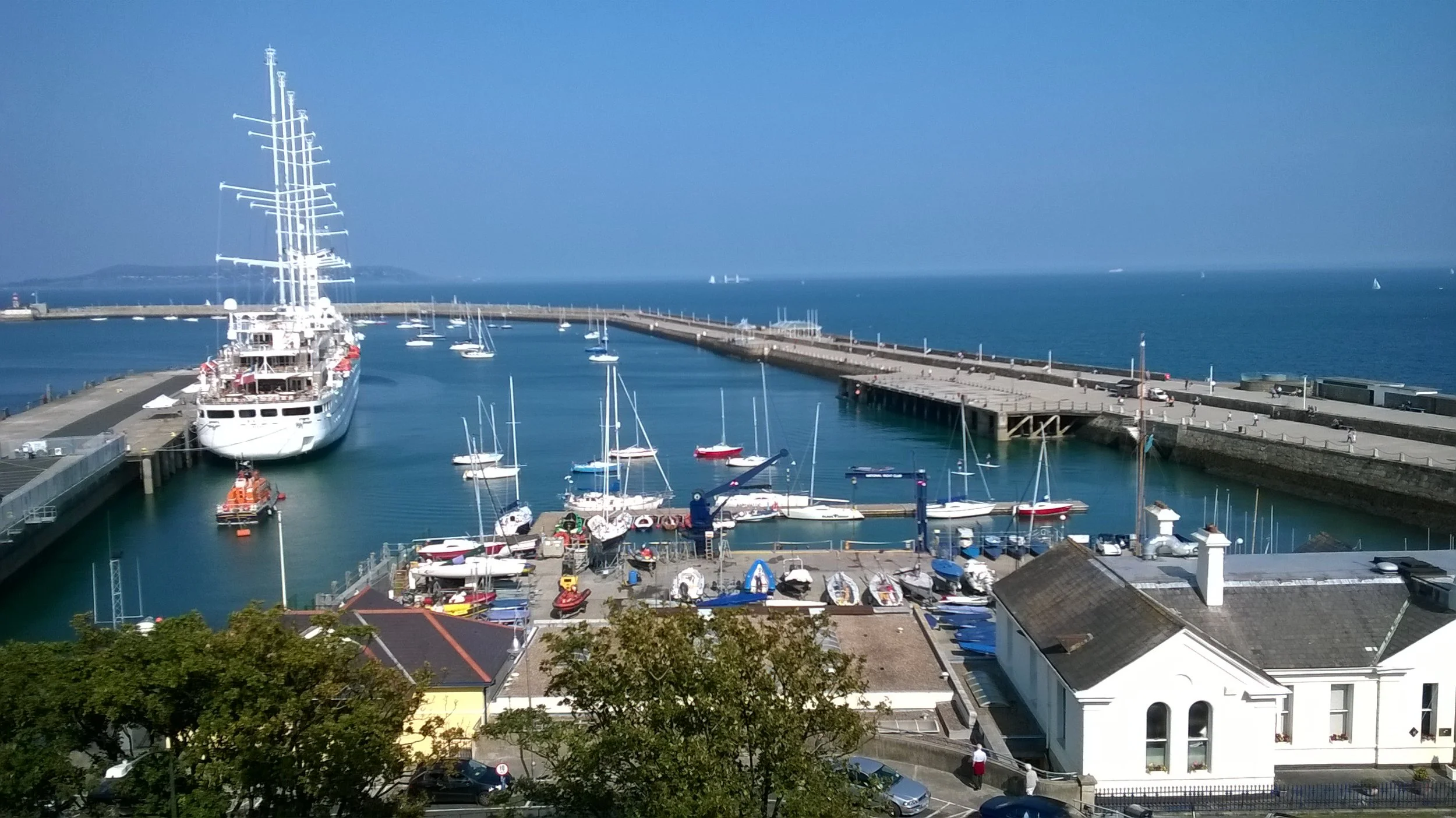
East Pier at Dún Laoghaire harbour.
I have lived in and around Dún Laoghaire for almost all of my life - 5+ decades! My mother still lives there in the town centre. It has been ‘the town’, ‘the borough’ or as my mother describes it, ‘the premier township’. It has always been home.
Every day, thousands of other people come and go through Dún Laoghaire without giving much thought to its name. Yet hidden within those two words lies a story of kings, warriors, slave raids, and one of the most famous figures in Irish history.
To understand the origins of Dún Laoghaire, let’s travel back more than 1,500 years to a time when Ireland was ruled by powerful Gaelic High Kings and the Irish Sea was a highway for trade, warfare, and raiding.
The Fort of Laoghaire
The name Dún Laoghaire translates as "Fort of Laoghaire".
The word "dún" means a fort or stronghold, while Laoghaire refers to Laoghaire (Lóegaire) mac Néill, a High King of Ireland who is believed to have ruled during the 5th century. His famous father was a man called ‘Niall of the Nine Hostages’ - but that is a blog for another day.
According to early Irish tradition, Laoghaire maintained a coastal fort in the area overlooking the harbour near the West Pier. The strategic position offered commanding views across Dublin Bay and easy access to the Irish Sea.
Although no trace of the fort survives today, the location became permanently associated with the king's name.
A King Connected to St Patrick
Laoghaire is best remembered as the High King who encountered St Patrick.
One of the most famous stories in Irish history tells how Patrick lit the Paschal Fire on the Hill of Slane around AD 433. The fire was visible from the royal seat at Tara and challenged the authority of the king and his druids.
Patrick was summoned before Laoghaire. While the king did not convert to Christianity, the encounter marked a turning point in the spread of Christianity throughout Ireland.
The story places Laoghaire at the centre of one of the defining moments in Irish history.
The Irish Sea and Slave Raids
The king's association with this stretch of coastline may have been more than symbolic.
In the 4th and 5th centuries and beyond, the Irish Sea was a busy maritime corridor. Irish raiders regularly crossed to Britain, bringing back livestock, goods, and captives as slaves.
Tradition holds that Laoghaire used his coastal stronghold as a departure point for expeditions across the sea.
One famous captive taken during this period was a young boy named Patrick. Enslaved in Ireland for six years before escaping, he would later return as the missionary now known as St. Patrick.
While historians debate the precise details, the connection between Laoghaire, the eastern coast, and the world of Irish Sea raiding forms an important part of the area's early story.
From Fishing Village to Kingstown
For centuries the name Dún Laoghaire remained attached to a small coastal settlement, but spelled variously as Dunleary or Dunlary.
The town changed dramatically following the disastrous loss of hundreds of lives in storms and shipwrecks in Dublin Bay in 1807. In response, construction eventually began on what would become one of the largest man-made harbours in western Europe.
When King George IV visited Ireland in 1821, the town was renamed Kingstown in his honour.
Throughout the Victorian era, Kingstown became one of the most fashionable seaside resorts in the then unified Britain and Ireland, attracting wealthy residents, visitors, and maritime traffic from across the empire.
The Return of Dún Laoghaire
Following Irish independence, there was growing interest in restoring traditional Irish place names.
In 1920 the town officially reverted to Dún Laoghaire, reconnecting the modern harbour town with its ancient origins and the High King whose name had survived for more than fifteen centuries.
Today, the name serves as a reminder that long before the harbour, the railway, or the Victorian promenades, this coastline was already linked to some of the most significant events in Ireland's early history.
Explore the Story Yourself
Many visitors see only the harbour and seaside promenade. Yet beneath the surface lies a story stretching from High Kings and St Patrick to Vikings, Victorian engineers, writers, revolutionaries, and maritime pioneers.
The Granite Coast guided walk explores these stories along the coastline between Dún Laoghaire and Dalkey, bringing to life the people, myths, and events that shaped one of Ireland's most fascinating coastal landscapes.